Agentic Optimization: A Self-Improving AI Research Loop
I built an agentic optimization loop for language-model research.
AI agents proposed candidate models, a strict evaluator scored held-out bits per byte, and a research ledger turned each result into a better next brief. Over six iterations, the loop moved from a 1.871 BPB byte-GPT baseline to a replicated 1.604 BPB sparse MoE result.
The important part was not that an AI agent wrote a model file. It was that the system kept improving its own research process: better rules, better prompts, better rejection criteria, and better guesses about what to test next.
This is not recursive self-improving AGI. It is a bounded research loop for language-model experiments, with a fixed compute budget, a held-out evaluation set, and one boring metric that every candidate has to face.
| Question | Answer |
|---|---|
| What was optimized? | Byte-level language-model experiments. |
| Who proposed candidates? | AI agents working from a shared brief and ledger. |
| Who judged results? | A separate evaluator using held-out BPB. |
| What improved? | Best known BPB moved from 1.871 to 1.604. |
| What made it work? | Strict evaluation, equal budgets, and persistent memory. |
That boring metric is the point.
# What Is Agentic Optimization?
Agentic optimization is the use of AI agents inside a measured improvement loop: generate candidates, run them under a fixed contract, score them with an external evaluator, write down what happened, and use that memory to choose the next search direction.
It sits near a long research lineage around search, learning, and self-improving systems: Rich Sutton’s “Bitter Lesson”, Schmidhuber’s Godel Machine, Jeff Clune’s AI-GAs, and newer work such as The AI Scientist, Darwin Godel Machine, and DeepMind’s AlphaEvolve.
My version is intentionally modest: can agents run a serious empirical loop for improving a small byte-level language model?
The setup was simple:
- agents design candidate models
- each candidate trains under the same token budget
- an evaluator scores held-out bits per byte, or BPB
- lower BPB means better next-byte prediction
- results go into a research ledger
- the next iteration starts from the ledger, not from intuition
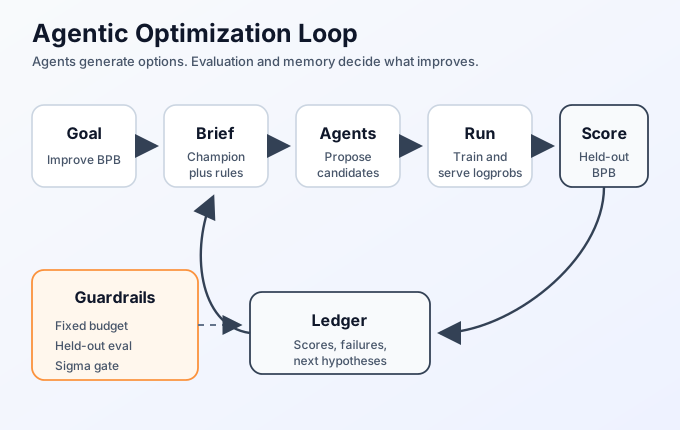
The loop is intentionally simple: agents can be creative because the evaluator is strict.
# The Rules That Made Agents Useful
The first lesson was that agents are not automatically good researchers. They are energetic proposal generators. Without rules, they over-tune, chase noisy wins, invent explanations too early, and spend compute on experiments that are hard to compare.
So the real work was designing the game they were allowed to play.
| Rule | Why it mattered |
|---|---|
| The orchestrator owns evaluation. | Candidate code cannot choose the held-out set or grade itself. |
| Every candidate gets the same budget. | Training was fixed at 120 million tokens, making runs comparable. |
| Held-out BPB is the metric. | No custom success criteria, hand-picked examples, or self-reported wins. |
| The held-out data stays held out. | Training used a loader that excluded the evaluation slice. |
| Noise is measured first. | Five baseline seeds gave a 1.871 mean BPB with sigma 0.0317. |
| Small wins do not count. | A result had to clear the noise scale before becoming a real claim. |
| Every iteration updates the ledger. | Results, crashes, timeouts, surprises, and assumptions became memory. |
The ledger mattered more than I expected. It stopped the agents from rediscovering the same lesson every round. Once those rules existed, the main agent could keep working: read the ledger, choose pressure points, spawn focused subagents, run candidates, score them, update the written rules, and repeat.
The human role changed from “pick the next model” to “design a loop where the next model choice has to be earned.”
# How the Research Loop Worked
Each candidate lived in its own directory with a manifest, code, and notes. After training, it had to serve a small local API:
- health check
- log probabilities
- shutdown
The evaluator sent held-out bytes to the candidate and computed BPB itself. This contract made very different ideas comparable: n-grams, compression-style models, GRUs, LSTMs, transformers, Mamba-style attempts, RWKV-style attempts, and sparse mixture-of-experts models all had to satisfy the same interface.
The experiment was small enough to run repeatedly, but strict enough to punish storytelling. That combination is the useful middle ground: creativity happens before evaluation, not during evaluation.
# Outcomes Over Six Iterations
The baseline was a small byte-level GPT: 6 layers, 384 dimensions, about 10.7 million parameters. It scored 1.871 BPB on the held-out set.
Then the agents started proposing alternatives.
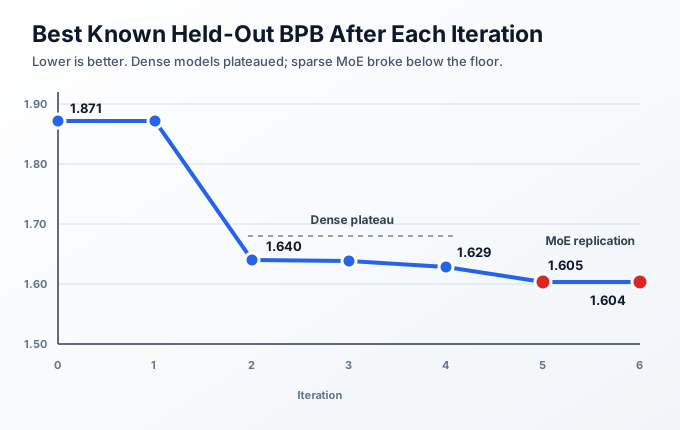
Best known held-out BPB after each iteration. Lower is better.
| Iteration | Best result | What happened |
|---|---|---|
| 0 | 1.871 | Baseline byte-GPT established the noise scale. |
| 1 | 1.879 | Classical and retrieval-heavy ideas did not beat the baseline. |
| 2 | 1.640 | A tuned modern transformer became the first major jump. |
| 3 | 1.638 | Dense transformer variants mostly tied the new plateau. |
| 4 | 1.629 | Training recipe changes helped, but only slightly. |
| 5 | 1.605 | Sparse MoE broke below the dense transformer floor. |
| 6 | 1.604 | A second full MoE run replicated the improvement. |
The biggest drop came from moving to a stronger modern transformer recipe. After that, dense transformer changes became much harder. Deeper, narrower, longer-context, and recipe-tuned variants clustered around the same region.
The next real improvement came from sparse mixture of experts. The best model,
iter6-moe-steps, reached 1.6037 BPB. A previous full MoE configuration had
reached 1.6052 BPB, close enough to look like a replicated pattern rather than a
lucky run.
A single run is a hint. Two independent configurations landing in the same region below the dense floor is evidence.
# Interesting Findings
| Finding | Why it mattered |
|---|---|
| A strict evaluator beat a clever prompt. | Claims stopped mattering. A candidate either served log probabilities and improved held-out BPB, or it did not. |
| Agents needed calibrated context. | After each round, agents received the current champion, the noise estimate, the budget, and known failure modes. |
| Diversity was not automatically useful. | Classical, retrieval-heavy, and unstable sequence-model attempts narrowed the search even when they failed. |
| Dense transformer tuning hit a local floor. | Once the recipe reached roughly 1.64 BPB, many plausible improvements became sub-sigma. |
| Sparse capacity helped. | MoE added capacity without paying full dense cost on every token, and two full MoE runs landed below the dense floor. |
The loop improved because failure stayed visible. Crashes, NaNs, timeouts, and weak scores were not embarrassing side notes. They became instructions for the next round.
# How the Agents Improved Over Time
The useful thing was not that an agent wrote a good model once.
The useful thing was that the loop became harder to fool over time.
By later iterations, the system had a better playbook:
- compare against the current champion, not the original baseline
- treat sub-sigma changes as noise
- prefer experiments that test a specific hypothesis
- preserve failures because they teach the next prompt
- separate proposal generation from scoring
- only promote a candidate after the evaluator agrees
That is the practical version of self-improvement here. Not a model rewriting its own source code into superintelligence, but a research process improving its own instructions, memory, and search priorities.
# Why “Agentic Optimization” Fits
“AI agent” is too broad. “Automated research” is too grand. “Recursive self-improvement” suggests something much stronger than what happened.
Agentic optimization is closer to the actual pattern:
- use agents to generate candidates
- use code to enforce the contract
- use data to decide winners
- use a ledger to carry learning forward
- repeat until the search stops paying rent
It is not magic. It is a disciplined optimization loop where language models supply imagination and software supplies accountability.
That shape can apply beyond language-model experiments: prompts, retrieval systems, data pipelines, compilers, model architectures, evaluation harnesses, or any domain where you can define a strict score and make candidates cheap enough to test.
# What I Would Improve Next
The next version should have a sealed test slice that is used less often, so the research loop cannot gradually overfit the main held-out set. It should add a small out-of-distribution canary, make failure analysis more structured, and push agents to produce more differentiated hypotheses instead of variations on the same favorite recipe.
Promotion should also be stricter:
- one seed to reject obvious losers
- multiple seeds for plausible challengers
- independent replication before calling something a new direction
That keeps the system fast when ideas are bad and careful when ideas look good.
# Takeaway
Agents become more useful when they are placed inside a loop that remembers, measures, and refuses to be impressed by prose.
For this experiment, agentic optimization moved a byte-level language model from a 1.871 BPB baseline to a replicated 1.604 BPB MoE result. The result is interesting, but the loop is the part I want to keep building.